Showing posts with label BOPP Films. Show all posts

Monday, 7 December 2020

Heat Resistant BOPP Films


Innovation is at the heart of everything we do at Cosmo Films. Our innovation is driven by the desire to cater to the current requirements and stay ahead of the times. In today’s times, ease of recycling of packaging laminates has become highly critical, and our heat resistant (HR) films facilitate mono-material structures and in turn recycling. Apart from recyclability, barrier heat resistant films also help with laminate structure rationalization without compromising on aesthetics, printability, machinability and user friendliness. 

Let’s take a quick look at what makes our latest product so special and why we are so proud of it.

Recyclability – Recyclability and sustainability are the future of packaging industry and if as a brand, enough stress is not laid on these two factors, then it might impact consumer outlook. Cosmo has specifically designed this film to replace BOPET film as printing layer in multi-layer laminates. With heat resistant films, we can now have BOPP/CPP structures or BOPP/PE structures which are part of the same family and therefore more conducive to recycle than PET/PE structure. 

Barrier features – For packaged food, the barrier features of a film are paramount. The BOPP based heat resistant films are also available in a barrier variant. The end pack made with barrier heat resistant film can be used for all food and personal care applications where moisture & oxygen barrier is of utmost importance. 

Grease resistance – The grease resistance offered by the films makes this category an ideal choice for oily snack food. It offers a clean grease barrier for greasy or oily food products. 

Versatility – The new heat resistant films are clear, non-heat sealable and both sides treated films with excellent printability and go mostly for reverse printing. The thermally stable films have excellent hot slip properties and good machinability, and therefore work well on high speed FFS packaging machines. 

Structure rationalization – The heat resistant films can be used for both two and three ply laminates. Since the barrier version of the film enables both printing as well as barrier, it enables construction of even 2 ply laminates. BOPP/CPP structures are common with the use of this film. 

Let’s take a look at other key values. 
  • Our new films are generally used as a printing layer in a duplex/triplex laminate structures either as BOPP/MET BOPP/PE or BOPP/CPP. 
  • The heat resistant BOPP films are available in 15, 18, and 20 microns.
  • The films are well suited for both adhesive as well as extrusion lamination. 
Cosmo Films is a global leader in speciality films used for packaging, laminating and labeling applications. Our films offerings include bi-axially oriented polypropylene (BOPP) films and cast polypropylene (CPP) films. Our new heat resistant BOPP films are not only a far better option in terms of sustainability but its barrier version also offers an enhanced shelf life to the packaged product. Contact us to know more about our heat resistant BOPP films.

Wednesday, 5 August 2020

The Journey of Plastics from a Linear to a Circular Economy

Plastic in India majorly constitutes 4-7% of the total waste in landfills, and only 1% remains in the system after being picked up and recycled. Still, plastic waste is given more attention due to its visibility in the system when compared to other more pressing issues in need of importance. Plastic, the wonder material has become omnipresent in our modern lifestyle. The strength, durability and malleability of plastics has made it the first choice of manufacturers. It has been able to replace other traditional materials, that too under a very short span of time; one of the causes behind our inexperience with the material and its properties. We’re still discovering and rediscovering information about its uses and management. It can be said that the human race is yet to solve the huge mystery of plastic disposal and its management.

The only solution is to adopt a circular economy, which aims to eliminate waste by its restoration and regeneration. What is actually waste for one, can be food for another? Same is the case with plastic waste. While we may have no use of the plastic package post the consumption of the product inside, but the same packaging can be recycled and made into something useful without being disposed of in landfills.

But human psychology has been following an entirely opposite route of “take, use and dispose” instead of take, use, dispose and recycle which has led to permanent damage to our planet. If everyone starts working according to the norms of Circular Economy, Earth will be a planet free from wastage and trash.

The circular economy offers you both, environmental as well as economic advantages. Let’s take a look at a few of them:

1. Economic Growth-

Circular Economy is the direct accelerator to the economic growth of a nation. It contributes to an increase in GDP and National Income. This is a result of an increase in the number of job opportunities and cheaper production by extracting the maximum use from all the waste. Implementing this directly increases the income and decreases the expenditure of each household.

2. Substantial Resource Saving-

Moving towards sustainable development is one of the most significant features of a Circular Economy model. As mentioned earlier, it proves to be a helping hand in saving resources as the focus remains on manufacturing products that are least acquired from natural resources.

3. Land Productivity and Soil Health-

With the help of the principles of a Circular Economy, we can bring a remarkable difference in productivity and health of the land. Because of a consistent effort to manipulate the uses of waste material disposed, we are making sure that land pollution is minimized at its best.

4. Fewer Emissions-

The aim is to counterattack the overload and exploitation of the ecosystem by reuse and dematerialization of waste materials being produced. Less use of non-renewable energies and fossil fuels promotes fewer emissions of toxic materials and greenhouse gases.

Plastics are also termed as a perfectly imperfect material. Perfect, because of its multiple uses, and Imperfect due to its non-recyclability. Most of the plastics look similar to each other and are difficult to distinguish with the human eye and hand, therefore, they are hard to segregate and recycle. If all the plastics had the same features and characteristics, we probably wouldn’t be having this conversation. But due to different components, types, chemicals, and colors plastic recycling has become extremely challenging for us. Their segregation is laborious, time-consuming as well as expensive. But in recent times, science has come across some miraculous ways to recycle and reuse it. Who would have thought of building roads with plastic or even generating electricity from the same material? HDPE (High Density Polyethylene), a kind of plastic, is recycled to make raised garden beds. Some of the other plastics that are also used in product packaging such as polyethylene terephthalate (PET or PETE), polyvinyl chloride (PVC), polypropylene (PP), are used in the construction of roads. They are first segregated and then shredded to mix with bitumen to create the mixture for roads. These plastic types can also contribute in the making of oils or construction of tiles or Plastones. There are many more ways to recycle and manage plastics instead of just dumping it in landpits post-consumption. It totally depends on us whether to plan plastic or to ban it.

One of the ways to recycle plastic is Heat Compression, in which all kinds of plastic polymers are taken together in huge containers, churned and then finally melted. This process does not require segregation of plastics for recycling. Another way to adopt Plastic Recycling is by using Monomer Recycling. This process involves Reverse Polymerization. The polymers are condensed within the same plastic which causes chemical components to reverse, creating a more stable recycled plastic.

The technical challenges have been solved by science and great minds but the major challenge lies in the behavioral change required in the society. The perspective and vision of humankind need to change when we talk of plastic and its reuse. This reckless behavior has triggered an avalanche of waste dumps in open areas. In order for humanity to co-exist with the earth, there is an urgent need to adopt a circular economy model and recycle our plastic waste in an efficient manner. Using plastics in a systematic manner can turn the tables around for the manufacturers as well as consumers. Instead of eliminating plastics from our lives, we can focus on how to implement their uses to get out of the Linear Economy phase. Reusing them smartly will be a revolutionary move for us as responsible human beings. Something to bring under the focus is that Circular Economy is not easy to implement. However, if we are able to put the wings of growth and sustainability on our economic system, then probably after centuries from now people will say that it was the Circular Economic Revolution that inaugurated a brand new era of development and prosperity in the nation.

Wednesday, 10 June 2020

Key Benefits of Flexible Packaging

From the use of aluminum containers to flexible packaging in the form of pouches or films, the packaging industry, especially for perishable products has come a long way. In the present day, the latter has become an essential, almost replacing rigid packaging. Flexible packaging is a non-rigid solution that can easily change its shape and be moulded into different forms like bags or pouches. It has wide applications that may vary from packaging solids to even liquid substances. Here are some key reasons why flexible packaging has proven to be beneficial across multiple industries.

Convenient & Lightweight 

  1. Flexible packaging solutions, available in forms like pouches, are easy to carry & store for consumers. 
  2. Features like zip locks and spouts add to its usability, making the consumer’s life easier by reducing the necessity of transferring its content into another container post opening. 
  3. These are light in weight and take less space. This makes transportation easier, drastically reducing the cost involved in shipping compared to heavier goods. 
  4. Since these are lightweight, it makes them less prone to damage. 
Prevents Spoilage 
Spoilage is one of the major concerns, especially in the food industry. According to FAO of the United Nations, food spoilage due to inferior packaging results in almost 1/2 of total food wastage across the world. To prevent this, companies have increasingly started using Barrier Films, a type of flexible packaging. These flexible films facilitate food safety by:

  1. Acting as Barrier: Certain types of flexible packaging act as barriers against outside elements like moisture, chemical and gases incl. oxygen which may otherwise become the reason for food degradation. 
  2. Preserving Inside Contents: While it does not allow entry of outside elements, it also keeps the inside aromas & food freshness intact. 
  3. Improving Shelf-Life: It increases the shelf life of food products by leveraging material that can aid in maintaining appropriate temperature and controlling the transmission of gases & other elements.
Environment-Friendly
All around the world, there have been various myths around this concern. Here’s why flexible packaging is beneficial for the environment as compared to other solutions:

  1. Use of flexible packaging reduces greenhouse gas emission as it consumes comparatively less power while being manufactured as opposed to its substitutes. 
  2. Both its production as well as transportation (since it’s easy to carry & lightweight) require less energy and make for a cost-effective & environment-friendly solution. 
  3. Its production involves less use of resources like fossil fuels and water. 
  4. It can be reused and recycled. 


Cost-Efficient 
Not only is it easy-to-handle & environment friendly but it’s a cost-effective solution too making it preferable for the manufacturers.

  1. It has a higher product to packaging ratio. This means that fewer resources are required in production of flexible packaging. 
  2. Even in the case of multi-layered films where material required for production increases, these eventually save the cost incurred by preventing food spoilage and wastage. 
  3. They are highly durable and reduce losses caused by tampering. 

Customizable & Innovative 
Flexible films can be moulded into any shape or form. The commonly used materials for this purpose are polyethylene, chloride and polyolefin. These can be easily converted into stand-up or lay-down pouches, or any other form of packaging.

  1. It enhances the look with its glossiness and clarity. 
  2. It gives graphic designers & marketers the opportunity to make the most out of the visual presentation, giving the product a competitive edge over the others. The designer can place his imagination & design freely anywhere on the package. 
  3. It offers amazing print quality so that the design could be brought to live effectively. 

With multiple producers in the market, it becomes hard to pick one. However, for Cosmo Films, a global brand accredited with prestigious national & international awards, one need not think twice. The company produces a variety of packaging films with versatile applicability & superior features. For more details, head over to the Cosmo Films website.

Wednesday, 20 February 2019

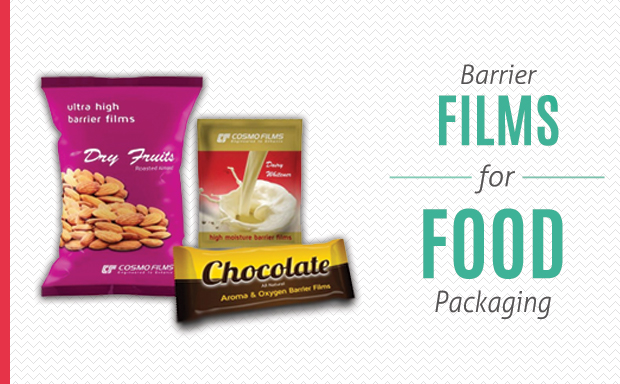
Barrier Films in Food Packaging


The most common challenge faced by the food industry is preserving, protecting and extending the shelf-life of food products. The quality of most food products gradually deteriorates over a period of time and affects attributes such as flavor, texture, taste and colour of the products. The shelf-life of food products can be shortened based on the interaction between a number of intrinsic (pH, preservatives, water activity) and extrinsic (temperature, humidity, gaseous environment) parameters.

Keeping this in mind, Cosmo Films has developed a range of solvent-free BOPP barrier films that can be used for a wide range of FMCG packaging applications. These barrier films not only help in extending the shelf life of food products but also reduce packaging material consumption through laminate rationalization.

What are barrier films? 

Barrier films are impervious packaging solutions, usually made up of single or multiple layers of flexible films, the material of which depends on the area of application. Barrier films are also coated on either side by different lacquers/resins to obtain desired results.

The effectiveness of a barrier film was earlier measured in terms of its ability to prevent the ingress of oxygen, carbon dioxide and moisture. However, in recent times protection against migration of mineral oil and UV light is also considered important. This impervious nature allows barrier films to protect products such as food from the loss of nutrients and functional properties such as taste, aroma, texture and colour.

The barrier films that are manufactured by Cosmo Films are solvent-free Bi-axially Oriented Polypropylene (BOPP), generally used in duplex or triplex laminate structures. BOPP started out as a replacement for cellulose film, which was used over 50 years ago, but it can now be used for a vast array of applications.

In typical manufacturing processes, a tenter frame is used to stretch the molten film in both machine and cross dimensions. The biaxial orientation of the film aids in reducing stretching, puncturing and tearing of the film.

Packaged Food


Applications of barrier films in the food industry 

Barrier films can be used to preserve and protect a wide array of food types and products, some of which are listed below:

Bakery Goods – These products require the use of perforated films in order to protect them from loss of humidity, while simultaneously preventing water retention so that their crispness stays intact.

Biscuits – These products are usually degraded by humidity uptake which leads to a loss of crispness. Products with chocolate and cream can be affected by oxidation and odor loss or uptake.

Dehydrated foods and beverages – These products require a very high barrier to water, aroma, and oxygen, so as to preserve their long shelf life.

Frozen foods – Raw, semi-cooked, cooked meats, and other frozen foods are highly perishable and need to be packaged using materials that can withstand minus degree temperatures.

Pet food – Wet pet food needs to be packaged using films that are impervious to oxygen, light, and contamination by odor.

Chips and snacks – These products usually degrade through rancidity and require packaging solutions which provide excellent moisture barriers.

Dry fruits, fruits and, nuts – These products need to be packaged using films that offer high gas, oxygen, and moisture barriers.

Types of barrier films
Cosmo Films manufactures three types of barrier films as below-

 1.Metalized Barrier Films :

[a] High Moisture Barrier (HMB): It is a metalized film that is corona treated on both sides and can be used for sandwich layer lamination in snack foods, shampoo sachets, dry milk powder and powdered drinks sachets/packs and all other products where loss of moisture is a prime concern.

[b] High Speed Barrier with High Hot Tack (HSB): The metalized moisture and oxygen barrier film has a High Hot Tack and Low SIT which enables FFS machines to run at a higher speed, thus helping to improve productivity.

[c] Ultra High Barrier (UHB): This metalized ultra high barrier film can be used to replace aluminum foil from multi-layer laminated structure since it offers an exceptional MVTR and OTR

Wednesday, 23 January 2019

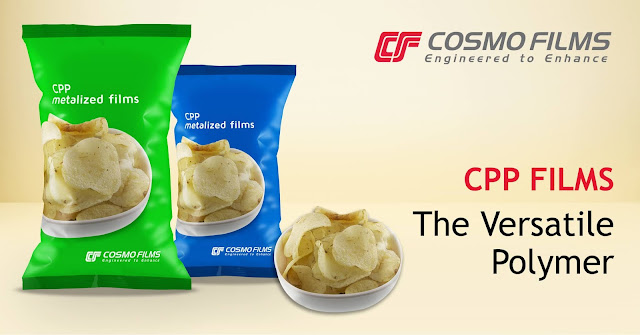
CPP Films – The Versatile Polymer

Polypropylene film or PP is a low density plastic film. The most important types of PP are cast polypropylene (CPP) and bi-axially oriented polypropylene (BOPP). Cosmo Films offer both these types of PP films. While BOPP is a more commonly known polypropylene film, the use of CPP in the food, pharmaceutical, flower, textiles and several other industries are consistently gaining popularity.


CPP Films

Some of the differences between CPP and BOPP are listed below for better understanding: 

  1. CPP is a soft film like polyethylene, whereas BOPP is a bit stiff and crinkly 
  2. CPP does not dead-fold well due to its natural living hinge, whereas BOPP has better dead-fold characteristics. 
  3. CPP can be ultrasonically or thermally sealed without the use of any specialty coatings, whereas BOPP does not heat seal well without the use of specialty heat seal coatings. 
  4. While BOPP films have better barrier properties than CPP, CPP has better barrier properties than most other polyethylene and PVC films. 

Cast polypropylene film is gaining favour as the material of choice in both traditional flexible packaging as well as non-packing applications. CPP has a higher tear and impact resistance, and better cold temperature performance and heat-sealing properties as compare to BOPP. There are various type of CPP films like general CPP, retort grade CPP, metalized CPP, solid white CPP and several other applications depending on the requirement and end application.

Some of the major benefits of CPP are listed below: 

  • Excellent heat seal strength, high puncture and tear resistance 
  • Excellent packaging integrity at extreme temperatures and high heat resistance 
  • No impact on the coefficient of friction (COF) control 
  • High yield per unit area and low specific weight (0.91 g/cm3) 
  • Offers good moisture barrier 
  • High transparency 

The health care and pharmaceutical industries use CPP films for packaging of drugs for extended periods of time since CPP films can protect against contamination. Application in other industries includes stand-up re-closable pouches, multi layered laminations, side-weld seal bags, flower and twist wraps.

Some of the major applications of CPP are listed below: 

  • Food Wraps or Candy/Confectionery packaging 
  • Bakery Products 
  • Lamination 
  • Garment Bags 
  • Retort Packaging 
  • Stationery Packaging 
  • Vacuum Metallization 
  • Deep Freeze Application 
  • Over Wrap 
  • Floral Wraps 

Metalized and General CPP films are the two leading types of CPP films used in the market. While the demand for CPP is higher in more developed countries like U.S, Canada, UK, Germany, the two countries that dominate in the use of CPP in the Asia Pacific region are India and China. With manufacturing units in India, Korea, and the USA, Cosmo Films is one of the leading manufacturer & exporter of CPP & BOPP films in polypropylene films category.

Sunday, 24 September 2017

The Best Companion for Food Packaging Solutions - Barrier Films

The use of barrier films prevents food items from deterioration by bringing down or preventing oxygen as well as water vapor penetration. The films are becoming popular as the volume of prepackaged foods grows. This helps sales outlets bring down the labor expenses of on-site packaging.

Some benefits of Barrier Films 

  • Shields food from ultra-violet rays 
  • Does not allow oxygen to enter the food package 
  • Does not permit odors to penetrate the package 
  • Ramps up moisture barrier properties 
  • Boosts gas barrier properties 

Barrier films are employed in most food packaging solutions particularly in thin plastic-based items. As the quality of food packaging solutions is dependent on the efficacy of the barrier it is imperative to choose the suitable kind of film for your specific purpose.


Barrier Packaging Films


Minimum Oxygen Transfer Rate 

One major factor to take into account is the oxygen transfer rate (OTR) of the pertinent film. OTR put simply is the quantity of oxygen that a barrier film permits to go through it. In majority of the food packaging solutions lesser oxygen is preferred. As high barrier films possess an oxygen permeability of 10 cc and lesser they are widely employed in food packaging applications.

As barrier films are versatile as well as reliable the former is surging in use year by year by the food packaging industry. There are a plethora of barrier films available today. Each provides unique advantages for different kinds of food items.

Ethylene vinyl alcohol barrier film is perfect for fish, meat as well as poultry packaging. The reason being the former possessing an OTR of 0.6.

Polyester(PET) is employed as a laminating substrate. The former’s advantages are heat resistance, potent oxygen barrier as well as superior durability. If laminated to certain miscellaneous materials it is an effective barrier to water as well as shields food products from UV rays.

Nylon is engineered to be microwaved or cooked as a result of its superior strength as well as relatively high melting point. Hence the former is widely used as well as popular in food packaging solutions. Polypropylene is a transparent, high barrier as well as flexible film offering excellent OTR as well as potent moisture barrier. LLDPE (Linear low-density polyethylene) offers transparency as well as excellent OTR perfect for flexible fresh produce food packaging.

Various combinations of the above barrier films are also leveraged in food packaging solutions.

Monday, 4 September 2017

Innovative Food Packaging Design for Maintaining Nourishment


Consistently, people run to markets, restaurants, and conventional stores because of one objective: to get some healthy food. Shoppers have a stunning measure of choice with regards to buying distinctive products, so it's essential for supliers and wholesalers to truly consider the sort of bundling they're utilizing for their items. Utilizing innovative design for food packaging can mean the difference between a customer picking up your products or leaving it on the shelf. Beyond looks, however, item security and freshness are two other huge elements that reason customers to pick one thing over another.

Packaging FilmsThings to Consider When Designing Packaging for Foods 

Further more, how the item looks on shelves, brands need to settle on a couple of other essential elements. For example, one advantage of utilizing plastic packaging is that it's very easy to make the packaging transparent so purchasers can see precisely what your item looks like exactly. If your item is visually appealing, transparent packaging can attract buyers to purchase the product, even if the item wasn’t on their shopping list. Especially for the readymade food, transparent packaging lets the customer see clearly what they’re getting.

Besides visual appeal, however, plastic packaging makes it simple to secure nourishment from wastage. Tamper Proof packaging is well known for food production brands, as this guarantees the item is safe and secure for clients. It's essential to work with a packaging production organization that is learned about various controls that protect nourishment. You should be able to offer your clients nourishment that is safe from contaminants noticeable all around the food.

What Materials Should You Choose? 

When you're thinking about various sorts of packaging for your food item, you'll have the choice to pick between an assortment of materials. Probably the most widely recognized materials utilized for nourishment bundling incorporate PE, PP, PET, CPET, HIPS etc. the sort suited best for your item will rely upon what it is that you are offering. In case you're uncertain what sort of material to utilize, it's optimal to talk about the scope of potential outcomes with your plastic packaging solutions supplier. They'll have the capacity to offer understanding on what material will work best for the nourishment you're offering.

For more information about food packaging and other packaging solutions, contact Cosmo Films Today!!

Sunday, 27 August 2017

Why BOPP Films has high demand in Packaging Industry

What is BOPP Film? 

Biaxially oriented polypropylene film (BOPP) is a thermoplastic polymer widely employed for packaging purposes. The film is termed "Biaxially oriented" as the film is stretched in 2 different directions.

Bi-axially oriented polypropylene (BOPP) films have existed in the world market for four decades and presently used on a large scale instead of waxed paper, aluminum foil and cellophane in several sectors.

Growth of use in Industrial Packaging 

There is an immense demand for BOPP films across the global industrial packaging sector owing to its comparatively higher strength and higher clarity over other types of packaging materials used today. For your information, BOPP films are relatively more flexible than most conventional packaging materials. This results in quicker packaging as well as enhanced sealing characteristics drawing many manufacturers of the food as well as non-food packaging industries to prefer it over traditionally used packaging materials. The excellent durability of the film makes it ideal for industrial packaging.


BOPP Films Manufacturer


The rise of the global flexible packaging industry

In recent years the worldwide demand for flexible packaging has substantially risen driven by demand from sectors including personal care, food and beverages and pharmaceuticals. BOPP films are being increasingly employed in flexible packaging resulting in high demand for it globally.

Properties of BOPP films which make it popular in the packaging applications 

  • It is more flexible 
  • It is light weight compared to other packaging materials 
  • Has high degree of flatness 
  • Unaffected by moisture 
  • High level of clarity 
  • Ease of printability 
  • Relatively higher strength 
  • Lower costs 
  • More convenient 
  • Does not shrink or wrinkle because of environmental variations 
  • Resistant to oils as well as greases 
  • Does not allow moisture to penetrate it 
  • Excellent puncture and flex-crack resistance over a broad range of temperatures 
  • Durable 
  • Attractive appearance 

Some popular packaging applications of BOPP films 

  • Textiles 
  • Garments 
  • Stationary 
  • Foods 
  • Beverages 
  • Tapes 
  • Adhesives 
  • Tobacco products 

BOPP is Environment Friendly 

Other reasons for the popularity of BOPP films that its manufacturing is safe as well as energy efficient. The latter property gives it an advantage over conventionally used packaging materials as governments and markets across the world are increasingly emphasizing on energy conservation. Also, it is possible to recycle as well as reprocess BOPP films into items for several new uses.

Metallized BOPP Film 

Metallized BOPP film is a type of BOPP film which is more attractive than the conventional BOPP film. Hence it is used to package luxury goods, wrap gifts and miscellaneous decorative purposes. Metallized BOPP is also significantly more resistant to gas as well as water vapor transmission. It is employed in packaging where moisture as well as aroma preservation is vital such as covering of tobacco goods and snack items.

Sunday, 20 August 2017

Expansion of Food Packaging materials and its varieties

In the old times it was seen that food packaging supplies were used to transport by various containers, nowadays it is not the case. While considering the sort of shipping devices utilized as a part of the past, the essential concentrate remained on the manufacturer's perspective. In Fact, till the finish of 19th century, for the most part all shipment handling methods utilized simple materials to transport their products to the market. Those holders were produced using clay, cork or wood.

But in the 20th century, there was a huge move in the materials utilized for Food packaging as the major part of them were produced using glass, metals and paper. Besides, another development took after as PETE (Polyethylene Terephthalate) material came in to existence. This adaptable plastic made bulk quantity of foods available accessible for circulation to consumers in these PETE compartments. The advantage was that the Polyethylene could be effortlessly stamped or formed in any possible shape. Likewise, it was reasonable to create, subsequently making it a economic packaging solution for foods. In any case, because of the rising ecological security mindfulness nowadays, this arrangement has made clients more pulled in to eco-friendly packaging solutions delivered from suppliers.


Food Packaging Films


Food Packaging is critical in conserving food the whole distribution chain. If not, different food processing risks can cause contamination because of direct contact with chemical, physical or natural contaminants. Regardless, in the previous couple of years, novel food packaging ideas and systems have upgraded the time span of usability of different foods. Subsequently, these measures have enhanced quality, wellbeing and manageability to the market. Such advancements have additionally helped to beverages, pharmaceutical medications, and other perishable items to be more beneficial for utilization and sale.

Some of the basic functions of Food Packaging 

Barrier Safety - Ideal food packaging shields the barrier from water vapor, oxygen, dust and so on. Saturation is the basic factor with regards to design. Food Packaging may incorporate oxygen safeguards, desiccants to expand the product usability time. An atmosphere controlled climate is essential for some nourishment bundles; this keeps the items fresh, sheltered and clean.

Physical security - Food Packaging may require pressure, shock vibration and temperature when encased in single package.

Various Varieties of Food Packaging: 

Food Packaging is fundamental to keep up the quality of the perishable products amid travel or for extended use. These varieties of packaging are explained below:

  • Primary packaging contains the primary package in which the sustenance is held for handling.
  • Secondary packaging holds numerous essential bundles in one box that is totally wrapped. 
  • Next bundling aggregates every single optional bundle in one pallet. 
  • Some exceptional food packaging compartments consolidate different advances to have most extreme durability and protection.

Thursday, 3 August 2017

Use of packaging films

With its inception in 1981 Cosmo Films is a leading manufacturer of Biaxially Oriented Polypropylene (BOPP) Films globally. It boasts of manufacturing entities in the United States, Korea and India. The company holds a BOPP manufacturing capacity of 136,000 TPA and had revenues of 249 million US dollars in FY 2015-16. Cosmo holds the distinction of being the biggest Indian BOPP films exporter. Additionally, it is the world's biggest producer of thermal lamination films.


The following are some of the different types of packaging films employed in the industry and their respective uses


Polypropylene (PP-OPP) Film - It is the most prevalent film. It is frequently employed in snack foods, candy, baked goods as well as several other industries. Almost 90% of the packaging makers use this film.

Polyester (PET) Film - As it possesses excellent heat resistance it is ideal for products cooked in ovens or microwaves. 

Low Density Polyethylene (LDPE) - It is the cheapest polymer film. It is frequently utilized for shrink applications including candles, compact disks, soap, pizza and more. 

High Density Polyethylene (HDPE)  - It possesses a high moisture barrier. Suitable for electronic components, cheese products, powders and more. 

Foil laminations - These are utilized for pharmaceutical goods as well as light sensitive items. 

Paper/polyethylene laminations - Their popular use is to wrap gauze bandages. Numerous frozen food items including burritos and pot pies are covered with this packaging film. 

Glassine Film - It's main use is for packaging fried items present in vending machines. 

Valeron Film - It is employed for covering chlorine tablets intended for swimming pools as well as toilet tanks. 

Shrink Film - Items packaged utilizing shrink films include candles, greeting cards, compact disks as well as trays of frozen items. 

Polyvinyl Chloride (PVC) - These films are utilized to package compact disks, greeting cards as well as candles.

 Other uses of packaging films are listed below 

  • They are light weight and simple to open, carry, store as well as reseal 
  • They extend the shelf life of several items particularly food. 
  • Offers convenience to customers 
  • Maintains as well as indicates freshness 
  • Ensures food safety 
  • Results in less overall waste being generated 
  • Minimal water and energy consumption 
  • Restrict greenhouse gas emissions 
  • Significantly limit transportation linked energy and fossil fuel consumption as well as environmental pollution Positively impacts sustainability profile 
  • Makes relatively easier the process of transportation and storage 
  • Brings down cost and enhances margins