Showing posts with label CPP Films. Show all posts

Wednesday, 25 August 2021

Cosmo Synthetic Paper: Your New Partner for the Printing of Certificates and Marksheets


 The education sector is one of the largest consumers of paper. From notebooks to maps, certificates & diplomas, paper is used in almost every activity. But the use of regular paper in universities & schools turns out to be an inefficient & non-sustainable solution, especially for durable applications like certificates, maps, diplomas, book covers and more. The key challenges in using regular paper are:

  • It is vulnerable, prone to damage.
  • It increases global deforestation.
  • When used with lamination, it is prone to peeling & scratches.

Cosmo Synthetic Paper (CSP) has turned out to be a perfect replacement for the conventional wood-pulp paper in durable applications for the education industry. CSP offers multiple benefits that resonate with industry needs and help in achieving both efficiency & sustainability. Scroll down to explore how.

WHAT IS COSMO SYNTHETIC PAPER?
Cosmo Synthetic Paper (CSP) is a white opaque, co-extruded, polypropylene-based BOPP film. It very closely resembles the conventional paper, yet has much more to offer. Made using synthetic substrates, it is extremely durable & eco-friendly as it involves no deforestation in the making. Thus, it’s the perfect substitute for wood-pulp paper in durable applications.

BENEFITS OF CSP FOR MARKSHEET & DIPLOMA APPLICATION
Mark sheets & diplomas are documents that students need even after they’ve completed their education. However, when printed on regular paper, these documents are prone to damage. They need the support of lamination, which again is expensive & not so durable. That is why universities are now switching to Cosmo Synthetic Paper for mark sheets, certificates, or diplomas. Here’s why:

UNMATCHED DURABILITY
CSP, designed to provide better durability, is made using synthetic substrates that offer distinct capabilities to the paper. CSP is:

  • Non-Tearable
  • Waterproof
  • Resistant to oil & chemicals

NO CURLING
Regular paper and even lamination start curling from the edges after a period of time. As a result, the users have to change the lamination from time to time to keep their documents intact. CSP eliminates the chances of curling from the edges with its excellent lay-flat property. Thus, mark sheets printed on CSP stay intact for years.

VERSATILE & QUALITY PRINT CAPABILITIES
The major challenge of using a synthetic substrate is ensuring print compatibility. CSP is a versatile solution that is compatible with multiple printing processes and technologies, including digital, thermal transfer, flexography, UV offset/inkjet & more.

SECURITY FEATURES
To avoid duplication or forgery of documents, users can add security features like micro printing, blind embossing, high-resolution border, invisible printing, void pantograph, hot foil stamping, watermark, serial numbering, QR code, prismatic printing, and others to documents printed on CSP.

REDUCED DEFORESTATION
The paper industry is a major reason for global deforestation. And with universities & schools consuming an enormous amount of paper in day-to-day use, they, too, are contributing to the deforestation process. CSP, made using synthetic substrates, does not require cutting down of trees in the production process, thus reducing deforestation and becoming an eco-friendly & durable substitute for conventional paper.

At Cosmo Films, we have partnered with multiple universities, Govt. institutions & schools to help them leverage the benefits of this revolutionary solution. We are creating a difference by delivering eco-friendly & efficient solutions for you & the environment. To know more about our product or to request free samples, you can connect with our executive

Source : https://www.cosmofilms.com/blog/cosmo-synthetic-paper-for-certificates-and-marksheets/

Tuesday, 9 March 2021

High Barrier CPP Films


Cast Polypropylene Films, usually known as CPP films are presumably the most pursued packaging solution, on account of its adaptability, adaptability, cost and power. Accessible in two sorts, General and Metalized high barrier films, CPP films are a one-stop arrangement not only for the food packaging and agricultural industries, yet additionally for the medical care and pharma industries. In this blog, we will examine the advantages of metalized high barrier CPP films. Known for its protection from tear and its strength, metalized high barrier CPP films are broadly utilized for food packaging needs. 

Let’s take a look at the top highlights of this variation – 
  • High oxygen barrier – Oxygen is the greatest contributor of food deterioration. This metalized CPP film blocks oxygen and assists with keeping up the time span of usability of the item. The packaging film offer an OTR of < 30cc/m2/day. 
  • High moisture vapour barrier – These metalized CPP films likewise give astounding barriers to moisture and humidity. The film offers a MVTR of <0.3g/m2/day 
  • High hot tack and low SIT – Hot tack power alludes to the peel force of the sealing region when it isn't totally cooled down.The hot tack is higher than 600gf/inch for a temperature scope of 100 – 140̊C, and a low seal initiation temperature, in this way making it simpler to laminate the film on a wide range of machines. 
  • High heat seal strength – At more than 2.3kg/inch, the heat seal strength offered by metalized high barrier CPP films is astounding. 
  • Seal initiation – These Packaging films offer a low and wide seal commencement temperature range (90 – 105̊C). The complete thickness range rests between 20 – 30μm. 
  • Excellent machinability – Metalized high barrier CPP films are not difficult to measure and offer great printability. 

About Cosmo Films Limited

Established in 1981, Cosmo Films is a global leader in speciality films for packaging, lamination and labeling applications. With engineering of innovative products and sustainability solutions, Cosmo Films over the years has been partnering with the world’s leading F&B brands, packaging & printing converters to enhance their consumer experience.

Company’s film offerings include BOPP and CPP films. Today, the company is the largest exporter of BOPP films from India and also the largest producer of thermal lamination films in the world. Its customer base is spread in more than 100 countries with manufacturing units in India, Korea & Japan.

Tuesday, 18 June 2019

Why CPP Films Are Becoming Increasingly Popular


Cast Polypropylene Films or CPP films have earned the reputation of being “versatile films” in the industry, and for good reason. CPP films score high on quality and performance, look aesthetically great, and are an ideal choice for flexible packaging, which is why these films are favoured in both traditional flexible packaging and non-packing applications. In this blog, we will take a closer look at what really makes CPP films special.

CPP films are made from polypropylene. Polypropylene is popular as a packaging material because it has low density and weight, is very versatile and cost-effective, and most importantly, is sustainable.

Let’s look at some of the major benefits of CPP:

Excellent Resistance To Tear – CPP films are very robust. Hence they have a high resistance to any kind of puncture and/or tear.

High Seal Strength and Hot Tack Strength - Both these values are exceptionally high making CPP films very robust and durable.

Multi-Material Structures - All the component properties of multi-material structures come together to optimize the performance, functionality, and total costs.

Offers Good Moisture Barrier - To extend the shelf life of the product, it is crucial that the film successfully protects the product from humidity, temperature and gases. CPP films provide a good moisture barrier and preserve product quality.

High Transparency - CPP films are completely transparent and attractive. Not only do they lend to the aesthetics of the product packaging, but also make it possible to see the product inside.

Good Optical Property - Great optical properties determine the shelf appeal of the product and CPP films with its versatility ensures that the look and feel of the product are not compromised.

Excellent Machinability - These films are easy to process and also offer great printability.

CPP films come in various varieties, but the general CPP and metalized CPP film are the most popular ones. General CPP films find widespread usage in the fields of food, agriculture and  architecture because of its transparency and sealing properties. In fact, the wrappers you see for confectionery and bakery products, or even fresh food are CPP films. From food packaging to  lamination and stationary, there is hardly a place where CPP films are not used. CPP films are used in the health care and pharmaceutical industries as well because these films provide a great  barrier against contamination.  

It is evident that CPP films dominate the Indian market. There are a couple of challenges posed by low-cost material but the advantages of CPP films supersede all of them.

Mr Pankaj Poddar, CEO Cosmo Films says, “We see more and more CPP being used globally as  well as in India as a choice material for packaging applications in food and agriculture owing to  its high transparency vis-a-vis polyethene and excellent sealing performance. Cosmo Films, with  years of experience in the polypropylene space, has worked hard to come up with an extensive  range of CPP films that it offers today both from functionality as well as mono-materialization standpoint.”


Wednesday, 23 January 2019

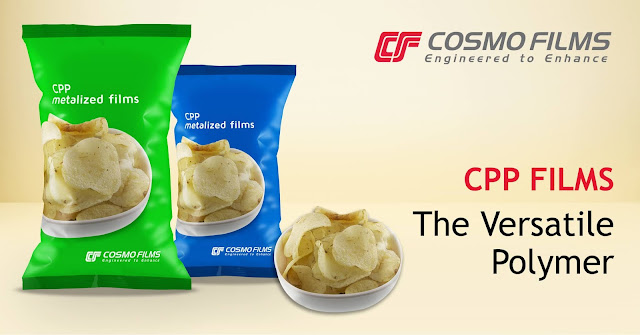
CPP Films – The Versatile Polymer

Polypropylene film or PP is a low density plastic film. The most important types of PP are cast polypropylene (CPP) and bi-axially oriented polypropylene (BOPP). Cosmo Films offer both these types of PP films. While BOPP is a more commonly known polypropylene film, the use of CPP in the food, pharmaceutical, flower, textiles and several other industries are consistently gaining popularity.


CPP Films

Some of the differences between CPP and BOPP are listed below for better understanding: 

  1. CPP is a soft film like polyethylene, whereas BOPP is a bit stiff and crinkly 
  2. CPP does not dead-fold well due to its natural living hinge, whereas BOPP has better dead-fold characteristics. 
  3. CPP can be ultrasonically or thermally sealed without the use of any specialty coatings, whereas BOPP does not heat seal well without the use of specialty heat seal coatings. 
  4. While BOPP films have better barrier properties than CPP, CPP has better barrier properties than most other polyethylene and PVC films. 

Cast polypropylene film is gaining favour as the material of choice in both traditional flexible packaging as well as non-packing applications. CPP has a higher tear and impact resistance, and better cold temperature performance and heat-sealing properties as compare to BOPP. There are various type of CPP films like general CPP, retort grade CPP, metalized CPP, solid white CPP and several other applications depending on the requirement and end application.

Some of the major benefits of CPP are listed below: 

  • Excellent heat seal strength, high puncture and tear resistance 
  • Excellent packaging integrity at extreme temperatures and high heat resistance 
  • No impact on the coefficient of friction (COF) control 
  • High yield per unit area and low specific weight (0.91 g/cm3) 
  • Offers good moisture barrier 
  • High transparency 

The health care and pharmaceutical industries use CPP films for packaging of drugs for extended periods of time since CPP films can protect against contamination. Application in other industries includes stand-up re-closable pouches, multi layered laminations, side-weld seal bags, flower and twist wraps.

Some of the major applications of CPP are listed below: 

  • Food Wraps or Candy/Confectionery packaging 
  • Bakery Products 
  • Lamination 
  • Garment Bags 
  • Retort Packaging 
  • Stationery Packaging 
  • Vacuum Metallization 
  • Deep Freeze Application 
  • Over Wrap 
  • Floral Wraps 

Metalized and General CPP films are the two leading types of CPP films used in the market. While the demand for CPP is higher in more developed countries like U.S, Canada, UK, Germany, the two countries that dominate in the use of CPP in the Asia Pacific region are India and China. With manufacturing units in India, Korea, and the USA, Cosmo Films is one of the leading manufacturer & exporter of CPP & BOPP films in polypropylene films category.